
Homebuyers: Hang In There
The pandemic created a tremendous interest in vacation homes across the country. Throughout the last year, many people purchased second homes as a safe getaway from the challenges of the health crisis. With many professionals working from home and many students taking classes remotely, it made sense to see a migration away from cities and into counties with more vacation destinations.
The 2021 Vacation Home Counties Report from the National Association of Realtors (NAR) shows that this increase in vacation home sales continues in 2021. The report examines sales in counties where “vacant seasonal, occasional, or recreational use housing account for at least 20% of the housing stock” and compares that data to the overall residential market.
This coincides with data released by Zelman & Associates on the increase in sales of second homes throughout the country last year.
As the data above shows, there is still high demand for second getaway homes in 2021 even as the pandemic winds down. While we may see a rise in second-home sellers as life returns to normal, ongoing low supply and high demand will continue to provide those sellers with a good return on their investment.
If you’re one of the many people who purchased a vacation home during the pandemic, you’re likely wondering what this means for you. If you’re considering selling that home as life returns to normal, you have options. There are still plenty of buyers in the market. If, on the other hand, you want to keep your second home, enjoy it! Current market conditions show that it’s a good ongoing investment. Please call (561) 316-6800 to schedule your consultation.
Building financial wealth and stability remains one of the top reasons Americans choose to own a home, and as a homeowner, your wealth often grows without you even realizing it. In a recent paper published by the Urban Institute, Home Ownership is Affordable Housing, author Mike Loftin illustrates how homeowners increase their equity and their wealth simply by making monthly mortgage payments:
“The principal portion that reduces the loan balance builds the homeowner’s equity. In doing so, the principal payments behave like an automatic savings account. The principal payment is not money going out; it is money staying in.”
But home equity – the difference between the value of your home and what you currently owe – isn’t just built through your monthly principal payments. Home price appreciation plays a vital role in growing your equity and, ultimately, your wealth.
As Freddie Mac explains:
“Homeownership has cemented its role as part of the American Dream, providing families with a place that is their own and an avenue for building wealth over time. This ‘wealth’ is built, in large part, through the creation of equity…Building equity through your monthly principal payments and appreciation is a critical part of homeownership that can help you create financial stability.”
CoreLogic recently published their latest Homeowner Equity Insights Report, and it shows continued growth in equity amidst record home price appreciation. The report provides several key takeaways, all of which point to rising wealth for homeowners:
Here, you can see the equity gains by state:
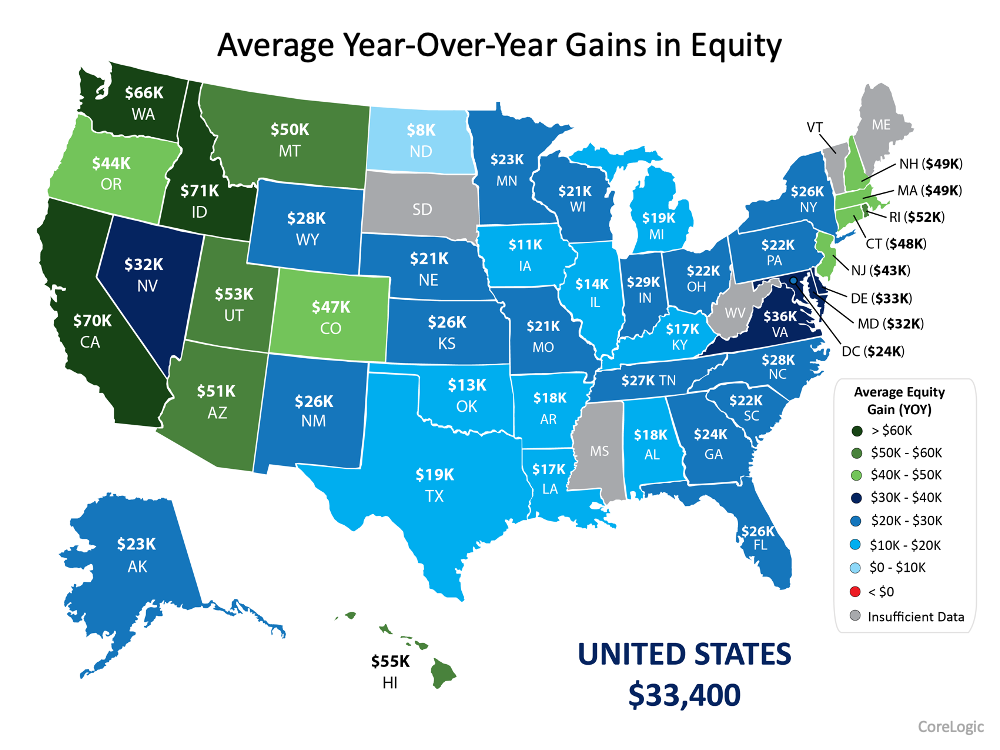
In addition to being a critical tool in building wealth, a homeowner’s equity also provides significant flexibility. When you sell your house, the accumulated equity comes back to you in the sale. Recent increases in home equity coupled with record-low mortgage rates mean it could be the perfect time for homeowners looking to make a move.
Mark Fleming, Chief Economist at First American, notes:
“Existing homeowners today are sitting on record amounts of equity. As homeowners gain equity in their homes, the temptation grows to list their current home for sale and use the equity to purchase a larger or more attractive home.”
Increasing equity also helps families facing challenges brought on by the pandemic. Frank Martell, President and CEO of CoreLogic, explains in the recent Homeowner Equity Insights Report:
“Homeowner equity has more than doubled over the past decade and become a crucial buffer for many weathering the challenges of the pandemic. These gains have become an important financial tool and boosted consumer confidence in the U.S. housing market, especially for older homeowners and baby boomers who’ve experienced years of price appreciation.”
Bottom Line
Home equity has always been a powerful wealth-building tool, and homeowners continue to see their financial stability increase. Let’s connect today so you can better understand how much equity you have in your current home or if you’re ready to take the next step in building your savings as a homeowner. Please call (561) 316-6800 to schedule your consultation.
If you are a US veteran having served in the military (or are currently serving at the moment) looking to buy a home, a VA home loan may just be the answer you are looking for. This is a special type of mortgage that is only offered to veterans and active service members. As a way to show appreciation to the brave men and women serving our country, the requirements for this type of loan are much less strict than those that will be required of a traditional mortgage loan application.
Even if the groundwork has already been laid out for veterans and service members that opt to apply for a VA loan, there are still instances where delays and setbacks may happen during the application process. This is why applicants have to map out a solid plan of action to take before they apply.
Applying for any type of mortgage requires patience and attention to detail. VA loans have been created specifically for veterans and active service members, who may not have the same resources as people who have not served in the military. This type of mortgage loan may not have the traditional requirements, but it will still require you to fill out paperwork and submit the necessary documents. It’s important to take time to double-check all the requirements you need to meet and paperwork you need to have. A good mortgage broker will guide you through the process and help you submit a complete application without skipping any crucial steps!
America’s Mortgage Solutions is a licensed mortgage originator based in Palm Beach, Florida. Our business is built on our industry expertise, partner relationships, and providing the highest service standards to every customer and loan we process. If you are planning to apply for a VA loan, contact us today at (561) 316-6800 and let us assist you!
For anyone who longs to purchase a home or two in their lifetime, the idea of dealing with mortgage payments can be quite intimidating because of how technical they can get. For first-time homebuyers, tackling and understanding the financial obligations that come with purchasing, owning, and maintaining a home is understandably confusing.
At this point in the home buying journey, there are a handful of different questions that you might have in mind as you flip through listings and weigh out your options. Whether you’re wondering what type of taxes you’ll be dealing with, the different loan options you can get, or how you can protect your investment, curiosity will definitely come aplenty.
Among the different concerns that you might have regarding the financial side of the home buying process, there’s one particular question that’s guaranteed to stand out: “What does my mortgage payment consist of?”
From a general perspective, it can seem like the figures of an average mortgage plan can be one too many since you have a whole list of particulars that create the total sum you’re expected to pay off each month. Fortunately, you won’t have to go into the payment process blindly because it can be broken up into what we’d like to call the P.I.T.I. structure.
Let’s go over each part in further detail:
While mortgage loans can differ in terms of the type of payment and application experience that you’re expected to undergo, they all share a common bond with respect to their different cost components. With this guide’s help, you can have a clearer understanding of what you’ll be setting yourself up to pay for in the long run until you’ve fully paid the loan off!
Are you thinking of buying a house in Palm Beach, FL, but you can’t pinpoint which loan option is best for you? America’s Mortgage Solutions can handle it all for you. Get in touch with us at (561) 316-6800 to learn more about how we can get you pre-approved today!
From vacation homes to secondary houses, people often find different reasons to invest in housing. If you’re investing in property to rent out or use as a vacation home though, that can potentially turn into a reliable source of income.
If this is something you’re interested in, read on as we share all you need to know about buying investment properties.
Let’s first get on the same page. When we talk about an investment property, what we mean is real estate purchased with the intent of generating income. This could either be through selling the property at a higher value or by renting it out.
A first-time home buyer should understand that buying a house with the intention of using it for their family is going to be different from buying a house for profit generation. Let’s make sure you get the basics before anything else.
Buying a house as an investment is going to put a lot of stress on your finances. For this reason, you’ll have to be more stable compared to buying a private home. Generally, housing loan providers require a 15% down payment. This condition normally does not exist if the loan is meant for the borrower.
In short, a first-time homebuyer will need to have enough capital to cover purchase costs, which includes inspection and closing costs, plus any work necessary to repair or maintain the home. You should also note that for property rentals, the property owner is responsible for essential home repairs. However, remember that in some states, the tenant is allowed to hold the payment if repairs are not made immediately.
It’s in your best interest to compute the potential Return on Investment before going about buying a house. This way, you can at least have an idea of how long you have to wait before you actually make money.
Here’s a summary of what you need to compute the ROI:
You’ll only need to go to the classified ads to research the prices of similar properties. Compute for the average price and then multiply that number by 12. This will give you an idea of what you might earn in a year.
This is simply the net value of your annual rental income minus the cost of operating your business. Operating expenses are any expenses that you incur during your business’s operations. This typically includes expenses on insurance, taxes, and maintenance. In some cases, there is even a homeowner’s association fee. Finally, you should divide the resulting value by the value of the housing loan, and this will give you the ROI.
Acquiring the horse won’t be the last step. You’ll still need to invest your time into managing the properties. Assuming that you’ve already renovated, you will then have to advertise the property. Also, property owners are suggested to interview any potential tenant before approving their lease to avoid any unnecessary stress in the future.
Other things to keep in mind include maintenance checks, and background checks of tenants, as well as having to follow up on rental payments.
Conclusion
It’s a good idea to plan way ahead so that you get ample time to work on everything, from your budget to the maintenance and monitoring of your investment. It’s hard work, yes, but it’s work that’s well worth the effort. On top of that, this is also why you need professional help to make your process smoother!
If you’re looking for help with your housing loan, America’s Mortgage Solutions is here to help. We can help first-time property buyers finance their purchases. Get in touch with us today at (561) 316-6800 to learn more about our services!
After getting pre-approval to buy your dream home, everyone expects to close the deal right away. However, the process is rarely ever that easy. Many buyers have to sit and wait for their lender’s home appraisal before they get the money to purchase the home. After all, they bear the risk in this investment. The home appraisal is there to ensure the money is not beyond the house’s actual worth.
That said, some home appraisals can end up with a value that is just much lower than the selling price or what you have offered. In this case, what should you do? Should you give up on the deal and move on? You could do that, but there are some things you can do before that.
Unfortunately, many deals end up a lost cause simply because the lender’s appraisal showed the home to be of much lower value. However, do not let the situation demotivate you. Follow the tips we have shared, and you might just salvage the situation and finally purchase the home with a fairer and better deal!
If your efforts look like a lost cause, do not be afraid to cut your losses and keep looking. As much as you want to buy your dream home, it is never recommended to pay for a home higher than its actual value.
America’s Mortgage Solutions is a licensed mortgage provider in Palm Beach, Florida, offering mortgage solutions to home buyers, investors, and more. We ensure the proper financial support for every homebuyer and investor. If you are looking for the best mortgage lenders to help you buy your dream home, reach out to us today at (561) 316-6800!
The median home value in the United States is around $247,084, and this could be a resource that you can tap into if you ever find yourself in a bind. While selling it and moving to another home is an option, this can be quite difficult, especially if you’ve already settled down. This is where a reverse mortgage can come in handy.
Now, the problem is that many Americans don’t understand or don’t even know what a reverse mortgage is. To help you out, we’ve prepared a brief guide that aims to explain everything you need to know about reverse mortgages. We’ll be discussing how it’s different from a conventional mortgage and talk about the reverse mortgage pros and cons so that you can make a more informed decision about your finances.
To put it simply, a reverse mortgage is a type of loan that’s only available to homeowners who are ages 62 and older. It allows them to borrow part of their home’s equity as tax-free income. This is essentially the opposite of a conventional mortgage, where the homeowner makes payments to a lender.
The unique aspect of reverse mortgages is that homeowners don’t make monthly payments. Instead of paying for the loan each month, the loan must be repaid in the case that the borrower passes away or if the home is ever sold.
One vital point to remember about reverse mortgages is that you can’t borrow your home’s entire value. This applies even if your entire mortgage has been completely paid for. Also, the amount that can be borrowed varies depending on several different factors. This usually includes the age of the borrower, the current interest rates, the Home Equity Conversion Mortgage (HECM) mortgage limit, and the overall value of the property. Older homeowners are more likely to get higher borrowing limits.
It’s also important to note that the interest on the reverse mortgage accumulates every month. As such, you’ll need to keep paying property taxes, homeowner insurance, and for the upkeep of the property.
Considering that reverse mortgages are a little more complicated than conventional mortgages, it makes sense that there are still things about it that people don’t understand. To help clear things up, we’ll be discussing and clearing up common misconceptions about reverse mortgages.
The first thing we have to address is the misconception that you can only reverse mortgage your home once you own it. This is inaccurate because it fully depends on how old the borrower is. If you are 62 years old, you can reverse mortgage your home as long as you have a minimum loan-to-value ratio of 45%. This varies depending on the age of the borrower, with older borrowers needing a higher loan-to-value ratio.
Another common misconception is that the lender will own the property that’s been reversed mortgaged. Similar to how a conventional mortgage works, the borrower will still own and keep the title of the property.
At this point, we hope that this article has helped you understand reverse mortgages better. At the same time, be sure to use this information wisely to make more informed financial decisions. Ultimately, you can always work with a professional who can guide you through your journey.
If you have any more questions about reverse mortgages or mortgages in general, we’re here for you. America’s Mortgage Solutions can help you figure out the best mortgage option that best suits your needs, whether you’re looking for conventional loans or first-time homebuyer programs in Palm Beach, FL. Get in touch with us today at (561) 316-6800 to see how we can help!
The threat of the COVID-19 pandemic still endures and has practically made many businesses and establishments grind to a halt, including the home buying market. Throughout the year 2020, home inventory was down across the country, although lower mortgage rates have sparked many people’s interest in buying a house.
The question is, “what changed in the mortgage application process ever since the pandemic and the lockdowns started?”
Whether you’re applying for a conventional mortgage, FHA loan, or a jumbo loan, the pre-approval stage is still the standard starting point when buying a house.
The purpose of pre-approvals is to confirm your income and ability to pay for your mortgage. You need to provide two years’ worth of tax returns and proof that you have an income-generating business in operation. The lender will also examine your credit score and debt-to-income ratio.
Now that lockdowns have been in place due to the pandemic, mortgage approvals are slightly different from before. For freelancers, documentation requirements have significantly become more stringent.
Lenders have made operational changes in their policies and requirements to protect themselves against losses in the pandemic-era economy. You need to present more proof of your ability to repay the loan, including year-to-date profit and loss statements as well as other supporting documents. They’ve also raised the minimum credit score and down payment requirements for mortgage applications.
As large parts of the home buying market start to resume operations and open up their services, you need to take a few steps to make sure you get a good deal on your mortgage.
Mortgage rates vary significantly; that’s why it’s essential to reach out to various lenders from big banks or regional banks. You should also hire a mortgage broker you can trust to work on your behalf to walk you through the long and arduous process of finding the right lender.
Establishing good relationships with a local banker can be of great help to your mortgage hunt. It can offer more leverage than the usual big-name banks out there.
Paying off your debt is a good step in improving your credit score, but what’s even better is to have a low credit utilization ratio. Take advantage of credit cards with a reasonably low outstanding balance but has a high credit limit. This can work well in giving you a lower credit utilization ratio.
Asking around can help you find better options when looking for a lender. Fellow homebuyers who’ve made successful deals on their houses can provide great insight. Check with your financial institution if they’ve heard of good home deals. Law firms, banks, and even employers are also great resources for homebuyers.
Mortgage lenders are still making loans, but they’ve made significant adjustments in their lending standards because of the market’s unpredictability. Because of the coronavirus pandemic, many borrowers are under a lot of financial stress. As a homebuyer seeking the best possible deal for a house, it’s best to work with someone to guide you through the changes in the lending process.
Finding a housing loan institution you can trust in the economy’s current state has never been more critical. That’s precisely why America’s Mortgage Solutions is here to help. We turn first-time homebuyers into lifetime clients by showing you the ropes on how to get a loan. Contact us at (561) 316-6800 and get pre-approved today!
If it is your first time buying a house in Florida, congratulations! You have chosen an excellent location. For sure, you are feeling excited, and a bit intimidated about the process of home buying. After all, you would need to go through detailed procedures and prepare various documents, from acquiring a housing loan to finalizing the property turnover. A massive chunk of your savings is at stake, so you need to make the right and well-thought-out decisions.
The process will definitely look overwhelming if you don’t know where to begin. What you need is to break it down and focus on the most important things first. Forget about the less important aspects for now. If you want to go through the process without feeling too burdened, follow our step-by-step instructions.
Buying a house can be complicated, but you do not need to dive deeply into everything at once. Start by dealing with these four items first and proceed to the next phase after. By securing these four crucial pieces of information, you can have a smoother home buying journey.
Finding the right house is only one of the many first steps, but finding a way to afford it is another. If you need to find the best home loan, contact us at (561) 316-6800 America’s Mortgage Solutions. Our goal is to help our clients get pre-approved while minimizing their tax liability and maximizing their cash flow.

Copyright © America’s Mortgage Solutions and its licensors | All Rights Reserved.
Terms of Use | Privacy Policy | TCPA Consent
Government Disclosures | Complaint Resolution | NMLS Consumer Access

America’s Mortgage Solutions is an Equal Housing Lender. As prohibited by federal law, we do not engage in business practices that discriminate on the basis of race, color, religion, national origin, sex, marital status, age, because all or part of your income may be derived from any public assistance program, or because you have, in good faith, exercised any right under the Consumer Credit Protection Act. Disclaimer: Programs subject to change without notice. All borrowers must qualify per program guidelines.


