Why 50% of Homes Are Selling for Under Asking and How To Avoid It
Why 50% (or More) of Homes Are Selling Below Asking Price — And How Florida Sellers Can Beat It
Meta Description:
More than half of U.S. homes now sell below list price. Learn why—and how Florida sellers can avoid under-asking outcomes with smart strategies.
Introduction
If your home sale strategy still assumes you’ll get multiple offers over asking, it’s time for a market reality check. The ultra-heated seller’s market is cooling, and data shows the shift is real. More than half of homes across the U.S. are now selling below their asking price—and Florida is no exception.
In this article, you’ll uncover:
-
The nationwide market shift driving more under-asking sales
-
Key Florida market data and local trends
-
Why pricing, timing, and negotiation matter more than ever
-
A step-by-step playbook for sellers in today’s climate
-
Local pitfalls to avoid and Florida-specific tips
Let’s dive in.
1. The National & Florida Context: What’s Changing
1.1 The National Shift
-
Recent reports show that more than 50 % of homes are now selling below asking. Realtor+2 Capitol Lien+2
-
In August 2025, the typical U.S. home sold for about 3.8 % under the asking price—the steepest discount since 2019. Redfin
-
Price reductions and negotiation room are growing. Redfin
-
This is a reversal from the recent past where many homes went above list price during bidding wars.
1.2 Florida’s Realities & Trends
Florida is one of the states feeling this shift strongly:
-
The median sale price for single-family homes in Florida in July 2025 was $410,000, down 1.7 % year-over-year. Florida Realtors
-
Condos and townhouses saw even bigger declines, e.g. -6.3 % for condo-townhouse units vs. same month last year. Florida Realtors
-
According to Redfin, Florida home prices are down 0.25 % year-over-year (at a certain recent snapshot). Redfin
-
Inventory is rising: more homes are listed, and homes are spending longer days on market. Redfin+1
-
In some Florida metros, six out of the top 10 U.S. metros where homes are selling the farthest under asking are located in Florida. Realtor
-
In ZIP code 33326 (Fort Lauderdale area), a recent report found ≈ 77 % of homes sold under asking. rocket.com
-
In Jacksonville, in May 2025, of ~983 homes sold or pending, 57 % sold under asking. rocket.com
-
In Naples, in April 2025, sale-to-list ratios for different property types ranged from ~94 % to ~96.4 % (i.e. not full asking). Ed DiMarco 1% Realtor
-
Some Florida cities, like Crestview, Deltona, and Ocala, have been identified as top U.S. cities with high shares of homes selling under asking. Florida Realtors
-
Florida’s housing market is “leading the slowdown” in U.S. price growth. Newsweek
These data points confirm that in Florida, sellers can’t count on automatic over-asking offers — local dynamics and strategy are critical.
2. Why It’s Happening: 6 Forces Driving More Under-Asking Sales
Understanding why homes are increasingly selling below asking is crucial to avoiding that fate.
2.1 Buyer Leverage & More Options
-
As more homes enter the market, buyers have greater choice and can walk away more easily.
-
In Florida, increased listings give buyers more leverage—less competition for every property.
-
Buyers are also more selective with budgets and conditions.
2.2 Rising Interest Rates & Buyer Affordability Constraints
-
High (or high relative) mortgage rates reduce how much buyers can pay.
-
Buyers stretch budgets less, leaving less room to bid over asking.
-
Some buyers were priced out of more aggressive bidding in past years.
2.3 Overpriced Listings & Missed Pricing Window
-
Overpricing leads to fewer showings, which sends signal: “something’s wrong.”
-
The first 10–14 days on market are critical: that’s when the most motivated buyers are active. If your price doesn’t attract interest early, your momentum dies.
-
Once a listing “ages,” perceptions shift—buyers expect negotiations, lower offers, perhaps unseen defects.
2.4 Comparables & Emotional Bias
-
Many sellers look at other listed homes (not sold comps), which overestimates market value.
-
Emotional attachment may inflate seller expectations (“I paid more,” “I’ve improved the home”).
-
Relying on “what I think it’s worth” rather than evidence opens you up to disappointing offers.
2.5 Local Market Imbalances & Micro-Trends
-
In some Florida neighborhoods, investor sell-offs are entering comps, pushing down valuations. Newsweek
-
Markets in Florida are heterogeneous: coastal vs inland, new construction vs established, flood zones vs non-flood. One-size pricing doesn’t work.
-
In high inventory metros in Florida, homes may face more competition from new build, resale, and distressed sellers.
2.6 Market Psychology & Buyer Caution
-
In uncertain economic environments, buyers act more cautiously, pushing harder in negotiations.
-
Buyers may request repair credits, contingencies, or demand upgrades.
-
Sellers who are rigid or inflexible face losing deals.
3. What This Means for Florida Sellers
If you’re listing in Florida (or anywhere in the U.S.), here are immediate implications:
-
You should expect negotiation — being firm is fine, but don’t be inflexible.
-
Your listing price must earn respect early — underpricing slightly is often safer than overpricing big.
-
Terms + conditions matter — if you can’t get full asking, you may win on repairs, closing cost credits, or faster timelines.
-
Market timing is key — do your listing when buyer activity is strongest.
-
Listings age = damage — avoid long days on market.
-
Flexibility and contingency adjustments become part of the negotiation toolkit.
4. Florida & U.S. Case Studies & Examples
Let’s walk through some real (or representative) Florida cases and what lessons they hold.
4.1 ZIP Code 33326 (Fort Lauderdale / Broward area)
In one recent snapshot, 10 out of 13 homes sold under asking, 3 sold at asking, and 0 sold over asking — ~77 % under asking. rocket.com
A home seller in that area who lists too optimistically risks missing the active buyer window.
4.2 Jacksonville, FL
In May 2025, of ~983 homes sold/pending, 57 % sold under asking. rocket.com
That’s a majority — even in a large metro — signaling sellers must price shrewdly.
4.3 Naples, FL (Selective Market)
Sale-to-list ratios in April 2025:
-
Condos: 94.1 %
-
Single-family: 96.4 %
-
Townhomes / villas: 95.0 % Ed DiMarco 1% Realtor
Thus, a $500,000 home might realistically sell for $480,000–$485,000 under certain conditions, depending on features, condition, and terms.
4.4 National / U.S. Trend Example
In August 2025, U.S. sellers were offering average discounts of ~3.8 % below list. Redfin
Even in markets outside Florida, this discounting trend shows up, reinforcing that sellers must adjust expectations.
5. Playbook: How Florida Sellers Can Avoid Selling Under Asking
Here’s your strategic blueprint. Each step is designed to counteract the forces pushing toward under-asking sales.
Step 1: Deep Local Market Research & Comps
-
Use recent sold data, not just listings. Look at homes actually sold in the last 30–90 days in your ZIP code or immediate neighborhood.
-
Break down comps by property type (condo, single-family, townhome), age, condition, lot size, flood risk, etc.
-
Use agents who know your micro-market: some Florida neighborhoods (beachfront, inland, older communities) have wildly different market behavior.
-
Watch for investor and distressed sales entering comps — they can pull pricing downward.
Step 2: Prepping & Staging to Minimize Buyer Leverage
-
Do essential repairs, cosmetic updates, and deferred maintenance — buyers often subtract for unseen issues.
-
Stage the home to show “move-in ready.” In Florida, emphasize features buyers like (pool, hurricane protection, landscaping).
-
Improve curb appeal — first impressions are huge.
-
Consider a pre-inspection report or disclosure to reduce buyer uncertainty.
Step 3: Price Smart (Not Emotional)
-
Avoid pricing at the top of your value band — you may lose showings.
-
Use price brackets or filters (e.g. $399,900 vs $400,000) to improve search visibility.
-
Consider pricing a little under the top range to drive urgency and activity.
-
Allow room for negotiation: if your true target is $420,000, listing at $425,000–$430,000 may invite lowball offers; listing at $418,000 might lead to a multiple-offer scenario.
Step 4: Timing & Listing Launch Strategy
-
List when buyer traffic is higher. In Florida, spring and summer often see stronger activity. Bankrate+1
-
Ensure your listing is “market ready” (photography, virtual tour, staging) before launch.
-
Do a soft launch (agent previews, broker open) to generate buzz before going live publicly.
-
Use online exposure, social media, targeted ads, and local MLS to drive early interest.
Step 5: Monitor & Be Ready to Adjust Quickly
-
In the first 7–14 days, track showings, feedback, offers. If traffic is weak, adjust price or reposition.
-
Be ready to act: small price adjustments early hurt less than big cuts later.
-
Consider making limited buyer concessions (closing cost credits, minor repair allowances) rather than deep cuts.
Step 6: Negotiate Creatively — Price Isn’t the Only Lever
-
Offer or negotiate repairs, closing costs, or faster closing to appeal to buyer constraints.
-
Be flexible in contingencies (inspection, appraisal) if safe.
-
If market supports it, consider “incubator offers” or “escalation clauses” (if you list in a somewhat competitive context).
-
Maintain a minimum acceptable bottom line in your mind—don’t let offers drag you into regret.
6. Pitfalls & Mistakes to Avoid (Especially in Florida Markets)
-
Overpricing based on emotion (e.g. “I spent $X” or “I love the upgrades”)
-
Ignoring local condition issues unique to Florida (flood risk, hurricane damage, mold, roof age)
-
Sticking to a rigid price when the market signals otherwise
-
Letting your listing age too long — each extra day increases negotiation risk
-
Showing only to “lookers” — ensure showings lead to serious buyers
-
Not adjusting marketing or staging when feedback indicates resistance
-
Over-relying on “future growth” rather than present data
-
Comparing to national trends too broadly — Florida has pockets that deviate.
7. Sample Scenarios & Model Calculations
Let’s walk through a couple of hypothetical examples to illustrate how much leeway exists, and how your actions influence outcomes.
Scenario A: Suburban Orlando Single-Family Home
-
Comps: Recent sold houses in area averaged 96 % of list.
-
If you list at $400,000, you might realistically sell around $384,000–$390,000 (assuming 3–4 % discount or negotiation).
-
But by prepping well, pricing a little under the top range (say $395,000), and launching with full marketing, you may attract multiple offers.
-
If you wait and drop to $380,000 later, the listing “ages” and you lose buyer confidence.
Scenario B: Coastal Condo in Miami
-
Condos often have higher discount rates due to maintenance fees, market sentiment, and buyer caution.
-
If comps show sale-to-list of 94 % for similar condos, listing at $300,000 means expected sale ~ $282,000–$290,000.
-
But if you overprice at $320,000, you may deter the buyer pool entirely, forcing you to drop to $280,000 later (a big cut).
-
Use creative negotiation on assessments, condo dues, renovations, or seller credits to capture value.
Scenario C: Urban Jacksonville Townhome
-
Suppose comps in your ZIP show 57 % under asking (as in recent data). rocket.com
-
You list at $320,000 expecting $320,000, but with negotiation you may end up with $292,000–$304,000.
-
If you launch at $310,000 instead, you may begin negotiation from $306,000–$308,000, narrowing divergence.
These scenarios show that your listing strategy directly determines how wide the gap will be between asking and sale.
8. Local Florida Tips (Coastal, Inland, High-Risk Zones)
-
Flood & Insurance Zones: If your house is in a flood zone or has high insurance costs, buyers will subtract value. Be transparent; show verified insurance quotes or mitigation improvements.
-
Roof age, hurricane prep, windows: These features carry outsized weight in Florida. Investing here can reduce buyer pushback.
-
HOAs & maintenance fees: In many Florida markets (condo, townhome, gated communities), HOA fees are a friction point. Be ready to address them.
-
Seasonality & tourism cycles: Coastal Florida markets can shift seasonally — winter buyers (snowbirds) may pay premiums; summer buyers may be more price-sensitive.
-
New construction competition: Many Florida markets have development, new homes, and spec builds competing — your resale must compare favorably.
-
Local agent network strength: Use agents tied to your specific metro (Miami-Dade, Broward, Hillsborough, Pinellas, Duval, etc.). They’ll know nuances and buyer behavior.
-
Marketing visuals: Use strong drone, twilight, water views, and outdoor amenity visuals — Florida buyers are often motivated by lifestyle.
-
Curb appeal & landscaping: Floridian landscaping — lush palms, tropical plants — can tilt perception positively.
9. Voice Search Optimization & SEO Keywords to Use
To increase your content’s visibility — especially for voice queries — use phrases your audience naturally speaks. Here are some suggestions you can weave in:
-
“Why are homes selling under asking in Florida?”
-
“How to avoid selling below list price in [City, FL]”
-
“What percent of Florida homes sell under asking?”
-
“How to get full asking price for my Florida house”
-
“Florida home sale negotiation tips”
Use conversational Q&A formats too:
“Q: Why are buyers getting more power in 2025?”
“A: Because inventory is rising, mortgage rates are higher, so sellers can’t list high the way they used to.”
Also include location modifiers: Florida, Miami, Tampa, Orlando, Jacksonville, Naples, etc. And tie in “under asking,” “below asking,” “sale to list ratio,” etc.
10. Full Draft Conclusion & Call to Action
Conclusion
We are in a market reset. The era when sellers could list aggressively high and expect bidding wars is fading. Today, more than half of homes in the U.S.—including many in Florida—are selling below asking price. That doesn’t mean defeat; it means strategy, execution, and adaptation matter more than ever.
The sellers who win now are those who:
-
Know their local comps and price accordingly
-
Prepare their homes to minimize buyer concerns
-
List during peak windows and maintain momentum
-
Monitor feedback and adjust early
-
Negotiate creatively beyond just price
If you want your Florida home to be one of those that sells at or above asking, you need a focused, data-driven approach.
Call to Action
Let’s talk specifics for your home. I’d be happy to help you:
-
Run a local comparables analysis for your ZIP code
-
Estimate your realistic selling range
-
Build a listing strategy tailored to your home’s strengths
-
Walk you through preparation, staging, and negotiation tactics local to your area
Want me to put together a free home valuation + tailored plan for your Florida address or neighborhood? Just send me your ZIP code (or city) and a few details (bedrooms, lot size, condition), and I’ll build it for you.

Why 50% of Homes Are Selling for Under Asking and How To Avoid It
If your selling strategy still assumes you’ll get multiple offers over asking, it’s officially time for a reset. That frenzied seller’s market is behind us. And here are the numbers to prove it.
From Frenzy to “Normal”
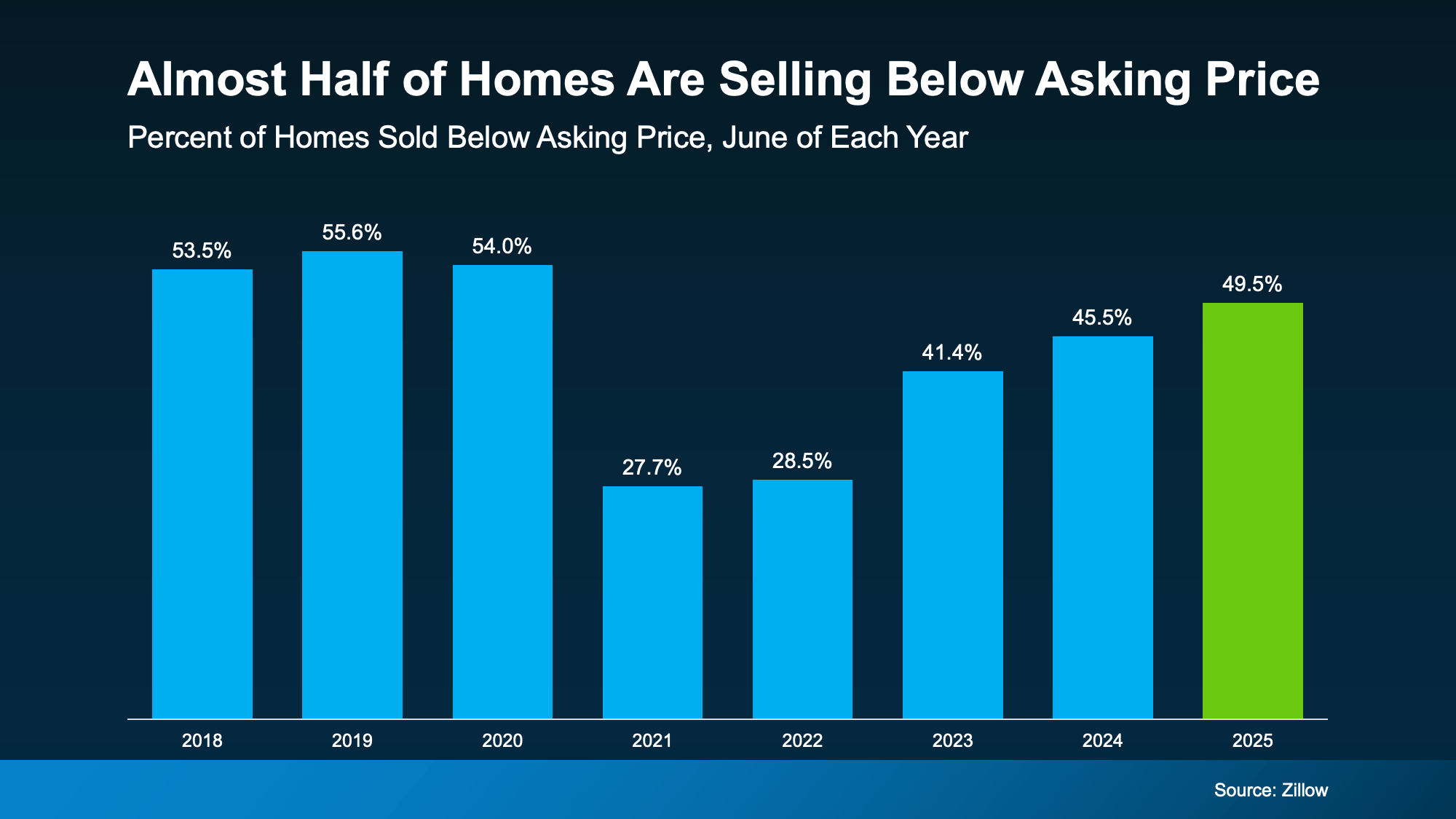
Right now, about 50% of homes on the market are selling for less than their asking price, according to the latest data from Cotality.
But that isn’t necessarily bad news, even if it feels like it. Here’s why. The wild run-up over the last few years was never going to be sustainable. The housing market needed a reset, and data shows that’s exactly what’s happening right now.
The graph below uses data from Zillow to show how this trend has shifted over time. Here’s what it tells us:
- 2018–2019: 50–55% of homes sold under asking. That was the norm.
- 2021–2022: Only 25% sold under asking, thanks to record-low rates and intense buyer demand.
- 2025: 50% of homes are selling below asking. That’s much closer to what’s typical in the housing market.
 Why This Matters If You’re Selling Your House
In this return to normal, your pricing strategy is more important than ever.
A few years ago, you could overprice your house and still get swarmed with offers. But now, buyers have more options, tighter budgets, and less urgency.
Today, your asking price can be make or break for your sale, especially right out of the gate. Your first two weeks on the market are the most important window because that’s when the most serious buyers are paying attention to your listing. Miss your price during that crucial period, and your sale will grind to a halt. Buyers will look right past it. And once your listing sits long enough to go stale, it’ll be hard to sell for your asking price.
The Ideal Formula
Basically, sellers who cling to outdated expectations end up dealing with price cuts, lower offers, and a longer time just sitting on the market. But homeowners who understand what’s happening are still winning, even today.
Because that stat about 50% of homes selling for under asking also means the other half are selling at or above – as long as they’re priced right from the start.
So, how do you set yourself up for success? Do these 3 things:
- Prep your house. Tackle essential repairs and touch-ups before you list. If your house looks great, you’ll have a better chance to sell at (or over) your asking price.
- Price strategically from day one. Don’t rely on what nearby homes are listed for. Lean on your agent for what they’ve actually sold for. And price your house based on that.
- Stay flexible. Be ready to negotiate. And know that it doesn’t always have to be on price. It may be on repairs, closing costs, or some other detail. But know this: today’s serious buyers expect some give-and-take.
If you want your house to be one that sells for at (or even more than) your asking price, it’s time to plan for the market you’re in today – not the one we saw a few years ago. And that’s exactly why you need a stand-out local agent.
Bottom Line
You don’t want to fall behind in this market.
So, let’s talk about what buyers in our area are paying right now. With local expertise and a strategy that gets your house noticed in those crucial first two weeks, anything is possible.
Want to know what your house would sell for?
Read from source: “Click Me”
Questions, Comments or For more information you can call
Christian Penner Branch Manager at 561-316-6800 or email us at TheMortgageTeam@ChristianPenner.com
Approval Hotline: 561-316-6800
Helping You Achieve the American Dream of Home Ownership


Or You can click “Call Me” below to call Christian Penner directly using Google Voice