Why Self-Employed Borrowers Get Denied Mortgages (And the No-Ratio Loan Solution Most People Don’t Know About)
— When Strong Income Still Gets Denied
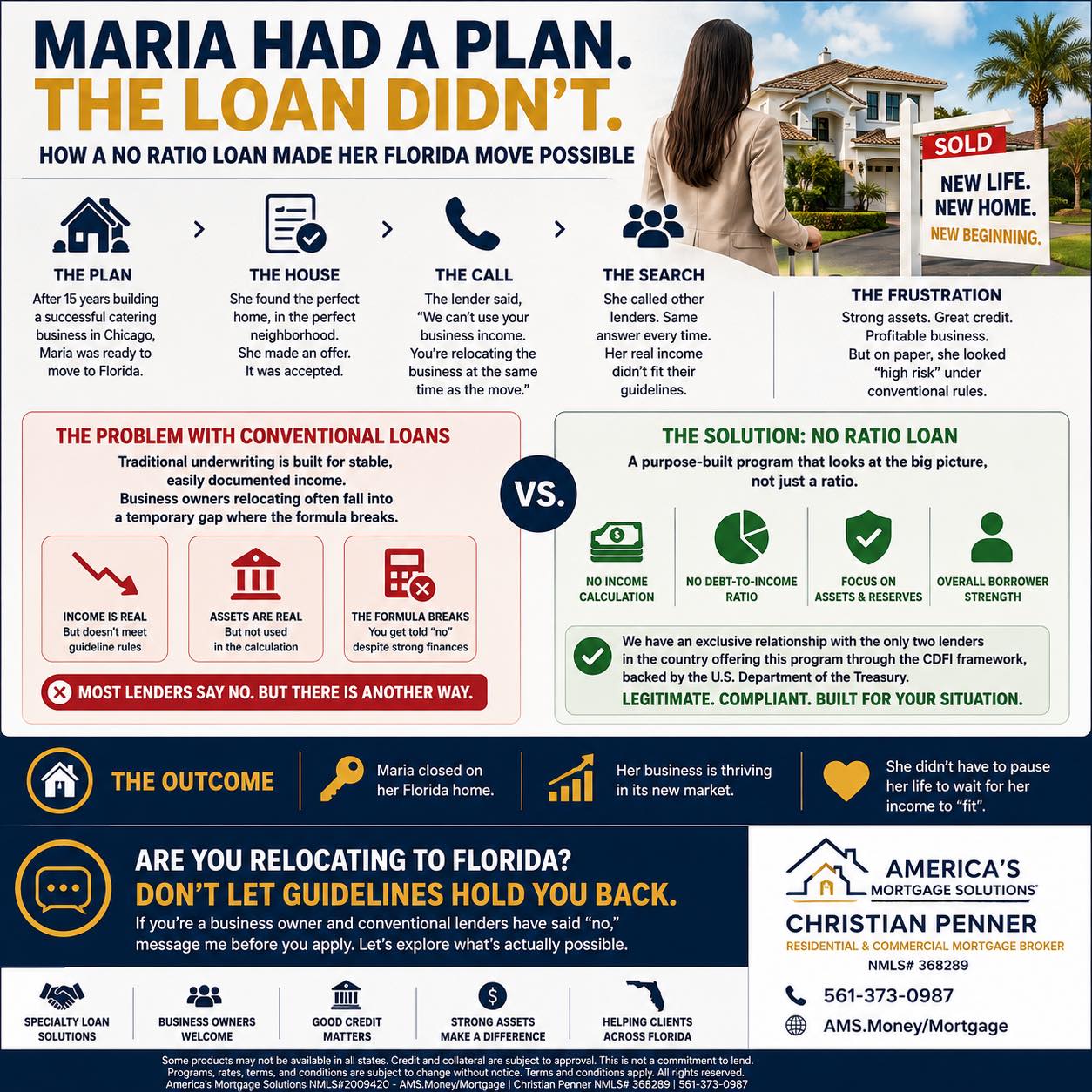
Maria thought everything was perfectly lined up.
After 15 years of building a successful business in California, she was finally ready to relocate to Florida. The house was exactly what she wanted—great neighborhood, strong schools, a backyard for her kids, and an accepted offer already in place.
Then came the call that changed everything.
“We can’t use your business income because you’re relocating your business at the same time as the move.”
She tried other lenders. Same answer.
On paper, Maria suddenly looked like a “high-risk borrower,” even though nothing about her actual financial situation had changed.
- Her business was profitable
- She had strong cash reserves
- Her credit was excellent
- She had years of stable self-employment history
The issue wasn’t her finances.
The issue was how the mortgage system interprets them.
Why Traditional Mortgage Underwriting Fails Self-Employed Borrowers
Most mortgage approvals are designed around predictable W-2 income. That works well for salaried employees—but not for entrepreneurs.
Income Documentation vs. Real Cash Flow
Self-employed borrowers are usually evaluated using tax returns. The problem is simple: tax returns often don’t reflect real earning power.
Business owners frequently:
- Reinvest income into growth
- Use legitimate tax deductions
- Show lower “adjusted income” on paper than they actually earn
So even strong earners can appear weaker on paper.
Relocation Creates Underwriting Disruption
When a business owner relocates—especially across states—lenders may flag the situation as unstable.
Even if the business is thriving, underwriting systems often ask:
- Will the income continue in the new location?
- Is the business continuity “proven” in the new market?
- Does this create a temporary disruption risk?
That uncertainty alone can lead to denial.
Debt-to-Income (DTI) Limitations
Conventional mortgages rely heavily on debt-to-income ratios.
If your income doesn’t fit neatly into their formula, approval becomes difficult—even if you have strong assets and excellent credit.
In other words:
If it doesn’t fit the model, it often gets declined.
The Real Problem Isn’t Your Income — It’s the Lending Model
The modern mortgage system was built primarily for salaried employees with consistent paychecks.
But today’s workforce looks very different:
- Entrepreneurs
- Freelancers
- 1099 contractors
- Business owners with variable income
These borrowers don’t fail financially—they simply don’t fit traditional underwriting systems.
So the issue isn’t strength.
It’s structure.
The Alternative Solution — No-Ratio Mortgage Loans
This is where alternative lending programs come in.
One of the most flexible options is the No-Ratio mortgage loan program.
What Is a No-Ratio Mortgage?
A No-Ratio loan does exactly what the name implies:
- No income calculation required
- No debt-to-income ratio used
- No reliance on tax returns for qualification
Instead of forcing income into rigid formulas, the focus shifts to overall financial strength.
What Lenders Evaluate Instead
Rather than analyzing reported income, lenders may focus on:
- Credit profile
- Liquid assets and reserves
- Overall financial stability
- Down payment strength
- Borrower risk profile
This approach is especially helpful for borrowers whose income is strong but not easily documented in traditional formats.
Who Benefits Most from No-Ratio Loans
This type of financing is not for everyone—but it can be extremely powerful for the right borrower.
It often works well for:
- Business owners relocating to another state
- Entrepreneurs restructuring or scaling businesses
- High-income self-employed borrowers
- Asset-rich individuals with complex income structures
- Buyers who have been denied due to documentation issues
If traditional lending says “no,” it’s often worth exploring whether the structure—not the borrower—is the issue.
Real-World Outcome — Maria’s Story
Maria’s situation is more common than most people realize.
- Traditional lenders declined her application
- Her income couldn’t be used due to relocation uncertainty
- Despite strong financials, she couldn’t qualify conventionally
Then she was introduced to a No-Ratio loan program.
Instead of focusing on income calculations, the approval focused on her:
- Strong reserves
- Credit profile
- Overall financial strength
She closed on her Florida home successfully.
More importantly, she didn’t have to delay her move or restructure her entire business just to satisfy outdated underwriting rules.
Her business is now operating successfully in its new location—and her home purchase didn’t slow that transition.
Why This Lending Strategy Is Growing
Situations like Maria’s are becoming more common due to:
- Increased remote work and business mobility
- More entrepreneurs relocating between states
- Growth in self-employment and 1099 income structures
- Rising home prices requiring more flexible underwriting solutions
As the economy evolves, lending structures are slowly adapting—but gaps still exist.
Key Takeaway for Borrowers
A mortgage denial does not always reflect financial weakness.
In many cases, it reflects a mismatch between:
- borrower structure
- and lending guidelines
The right loan program can completely change the outcome.
When to Speak With a Mortgage Professional
It may be helpful to consult before applying if:
- You are self-employed
- You are relocating for business
- Your income is complex or inconsistent on paper
- You have already been denied by traditional lenders
- You want to structure financing before making an offer
Early planning can often prevent unnecessary denials.
Disclaimer
Some products may not be available in all states. Credit and collateral are subject to approval. This is not a commitment to lend. Programs, rates, terms, and conditions are subject to change without notice. Terms and conditions apply. All rights reserved. America’s Mortgage Solutions NMLS#2009420 | AMS.Money/Mortgage | Christian Penner NMLS# 368289 | 561-373-0987
Read from source: “America’s Mortgage Solutions (AMS)”
Questions, Comments or For more information you can call
Christian Penner Branch Manager at 561-316-6800 or email us at TheMortgageTeam@ChristianPenner.com
Approval Hotline: 561-316-6800
Helping You Achieve the American Dream of Home Ownership









Or You can click “Call Me” below to call Christian Penner directly using Google Voice






Legal & Compliance
Privacy Policy: https://AMS.Money/Privacy_Policy
Privacy Policy & Disclosures: https://AMS.Money/Privacy-Policy-Disclosures