The 3 Things You Risk by Pricing Too High
When selling your house, the price you choose isn’t just a number, it’s a strategy. And in today’s market, that strategy needs to be sharp.
The number of homes for sale is climbing. And that means buyers have more choices and can be more selective. If your price doesn’t line up with what else is out there, they’ll scroll right past it and go on to the next one.
Pricing right from the start is your best move – and a great agent can help make sure you do.
Overpricing Comes at a Cost
And more sellers are finding that out the hard way. They list their house based on how things were a year ago – or based on a neighbor’s sale that happened under completely different circumstances. Then, when their house doesn’t sell, they’re left with three tough choices:
- Drop the price: Cutting the price might help get more eyes on the house again, but it can also trigger red flags. Buyers may wonder what’s wrong with it. And that’s going to impact any offers you get after the price cut.
- Take it off the market: Some sellers give up on the idea of selling right now. The worst part about this is it means putting their future plans on the back burner. That dream of more space, downsizing, or relocating? On pause.
- Rent it out: Others go the landlord route, but managing tenants and navigating leases isn’t always the simple fallback it seems. Renting can work, but it’s often a lot more hassle than people expect.
None of those options were part of the original plan. And honestly, none of them are where you should end up if you wanted to sell. Here’s a look at how a local agent’s expertise can help you avoid these headaches. Let’s use price cuts as an example.
Where You Live Makes a Difference
While the number of price cuts is up nationally, data shows some parts of the country are seeing far more of them than others. It all comes down to how much inventory has grown in that area (see map below):
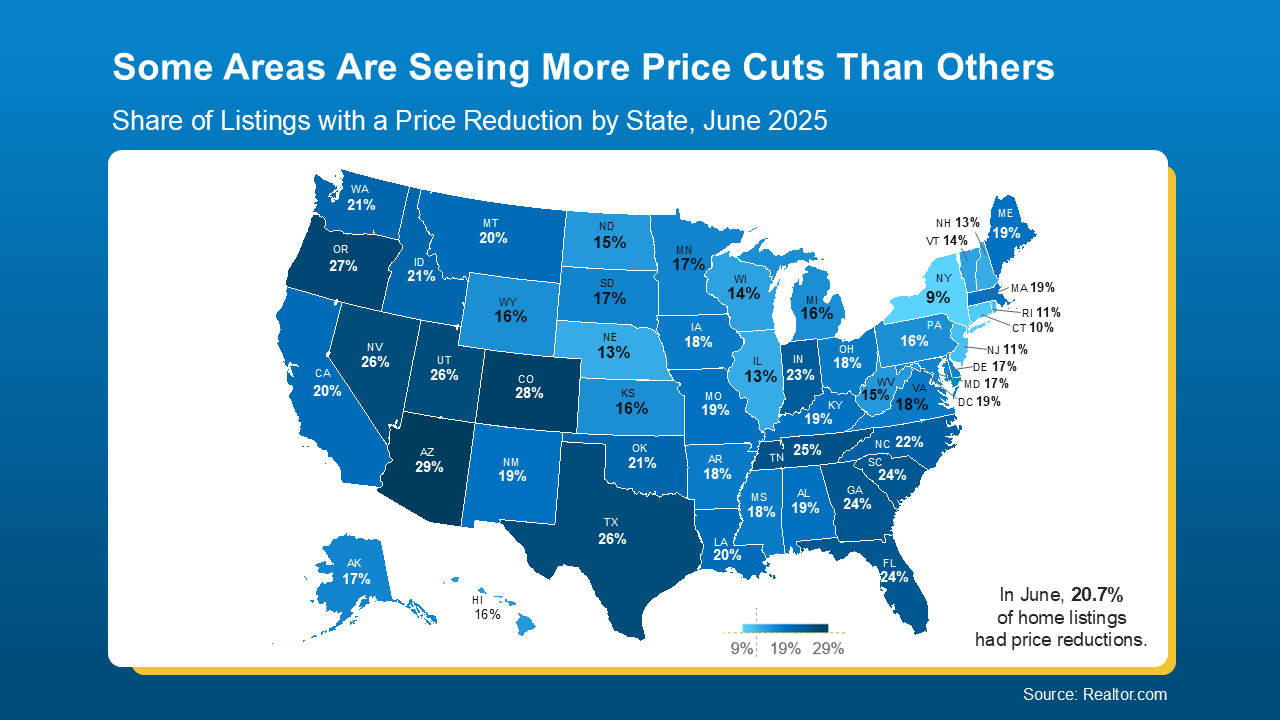 As Realtor.com explains:
“Regionally, price reductions in June were significantly more common in the South and West (23% of listings) than they were in the Northeast (13% of listings), reflecting the inventory divergence across these regions.”
That means pricing isn’t one-size-fits-all. What’s happening nationally might not reflect what’s happening in your zip code, and that’s why you shouldn’t try to determine your list price on your own.
How a Great Agent Helps You Nail the Price
A skilled agent doesn’t just toss out a number. As Zillow says:
“Well-priced homes are more likely to sell quickly, but pricing your home to sell quickly and for maximum dollar requires strategy and knowledge of your local market. You need to have a clear-eyed view of your home in relation to the competition, and knowledge about whether you’re in a buyers or sellers market. It also helps to know what buyers in your area can afford.”
And that’s all knowledge your agent will have. They study your local market, compare recent sales, and factor in your goals and buyer behavior. Based on what’s happening where you live, sometimes the best play will be pricing right at current market value. Other times pricing a little lower actually will spark more offers and ultimately get you a better final sale price.
So don’t skimp on the strategy or on your agent. With their local market know-how, you’ll be able to sell quickly, even in a shifting market.
Overpricing can lead to tough choices you never want to face. But with the right price, and the right guidance, you can skip the stress and sell with confidence. Let’s connect so you have a pricing strategy that works for today’s market and gets you where you want to go.
Read More About:
The 3 Things You Risk by Pricing Too High
Act One: The Allure of Overpricing – And the Peril Beneath
You’ve made the bold decision—selling your house is no longer a someday dream. The “For Sale” sign is waiting. The driveway is spotless. And yet, one critical move stands between you and success: the list price.
Too many sellers fall into the same costly trap. They look at their beautifully renovated kitchen, the pristine backyard, the high-end finishes… and they set a number that feels emotionally satisfying but strategically flawed. In a shifting market, that’s a dangerous game.
Today’s buyers and sellers market is a dance of precision. The number of homes for sale is climbing in many areas. That means selective buyers, with options galore, are taking a clear-eyed view of your home and stacking it up against others in the same price bracket. Miss the mark, and they’re gone—off to the next home for sale that feels more in tune with current market conditions.
When overpricing becomes your opening move, the consequences ripple out fast and far.
Risk #1: Price Cuts and the Shadow of Doubt
Let’s start with the first and most immediate backlash: the dreaded price reduction.
What seems like a smart buffer at first—“we’ll start high and negotiate down”—quickly turns into an Achilles heel. As weeks pass and showings dwindle, that inflated list price begins to rot on the vine. Eventually, you’re forced to drop the price.
But by then, the damage is done.
Buyers watching your listing from the sidelines begin to ask: “Why isn’t it selling?” It becomes a neon red flag in their eyes. Suspicion seeps in: maybe there’s something wrong with the house. Maybe you’re desperate. Maybe you’ll go even lower if they wait.
Realtor.com reports a clear trend in this regard—more sellers are finding themselves caught in this cycle of listing high and chasing the market down. These price cuts not only hurt your leverage, but they also rarely restore confidence. They dilute urgency. They wound the perceived market value of the property.
Your hopes of a strong final sale price? Fading fast.
Risk #2: Dreams Deferred – Or Worse, Dreams on Pause
Sometimes, the house just doesn’t sell at all.
When the listing expires, sellers are left at a crossroads. For many, this was more than a transaction. It was supposed to be the bridge to a new life—downsizing, relocating, upgrading, or escaping the HOA hellscape next door.
Instead, they’re left with three unpleasant alternatives:
1. Take it off the market
Give up. Retreat. Wait. But while you wait, life doesn’t. That move to be closer to family? Delayed. That waterfront condo you’ve been eyeing? Sold to someone else. That mountain retreat dream? On pause.
2. Rent it out
Sounds like a sensible backup—until you step into the chaotic world of tenant management. Leaky faucets at midnight. Unpaid rent. Property damage. Becoming a landlord wasn’t part of the original selling strategy, but now you’re deep in it.
3. Sell later… maybe
But “later” can mean six months—or six years. And who knows what current market conditions will look like then? Especially in regions where inventory is surging, like the West, these hesitations can cost you more the longer you wait.
As Zillow notes, “Pricing your home to sell quickly and for maximum dollar requires strategy and knowledge of your local market.” Postponing that decision might cost you more than just money—it could delay your life plans.
Risk #3: Missed Opportunities in a Hyper-Aware Market
Modern home buyers aren’t wandering blindly into the market anymore. They’re data-driven. Empowered. They’ve seen the listings. They’ve crunched numbers on West Palm Beach mortgage calculators. They’ve secured mortgage preapproval in West Palm Beach before attending open houses. They know what’s out there.
So, when your home is priced outside the expected range, it doesn’t just get skipped—it gets dismissed.
The biggest risk here? You’re not even in the running.
When well-priced homes in your area are flying off the market in days, and yours lingers, you’re invisible to your most motivated buyers. You miss the flurry of attention that comes in those first two weeks—the critical window when your property is “fresh” and exciting.
Without that buzz, your home for sale becomes stale. The urgency disappears. And so does your shot at a bidding war or full-ask offer.
Why This Happens: Emotion vs. Strategy
A house isn’t just a structure. It’s your child’s first steps. It’s birthdays. Holidays. Milestones.
But when you’re setting the list price, sentimentality can’t guide you—pricing strategy must.
The smartest real estate agents take emotions out of the equation. They lean into comparative sales, recent neighborhood data, and the nuances of inventory divergence between ZIP codes.
You may see a three-bedroom colonial. They see how it stacks up against six similar homes in the school district, three of which sold last month—two above asking, one with concessions. That’s the difference between instinct and agent expertise.
As Zillow puts it: “You need to have a clear-eyed view of your home in relation to the competition.” That’s where a skilled agent shines. They understand national trends vs local market conditions. They live and breathe housing inventory metrics. They know what buyers in your area can afford, especially if they’re using Affordable West Palm Beach home loans or applying through local mortgage lenders in West Palm Beach.
The Local Advantage: Leaning Into Your Agent’s Expertise
The truth? Pricing your home right isn’t a one-size-fits-all algorithm. It demands local market know-how.
Take West Palm Beach, for example. The number of listings might be up, but depending on your neighborhood, school district, or even street, demand may still be outpacing supply. Your local agent’s expertise is crucial here. They’ll understand when a slightly below-market price might spark a bidding war—or when a firm number will reinforce premium value.
They’ll also be tapped into buyer behavior: Are first time home buyer loans in West Palm Beach popular this season? Are high-net-worth investors looking for rental properties? Is there a new construction boom siphoning away demand?
They’ll even know if buyers are talking to a West Palm Beach mortgage broker about refinancing options, or looking into commercial mortgage broker in West Palm Beach for multi-use properties. That insight gives them leverage to craft a pricing strategy that works not just for your house, but for today’s market.
Pro Tip: Look Beyond the Zestimate
Sure, Zillow offers a quick estimate. But that’s a broad stroke.
True home pricing is surgical.
A great real estate agent blends hard data with boots-on-the-ground context. They’ll assess your hardwood floors, the updated roof, and yes—even that avocado green bathroom you haven’t gotten around to changing. They’ll factor in what similar homes have sold for and what buyers are actively looking for.
They’ll compare your property against those lingering on the market and those that sold lightning-fast. That’s where comparative sales shine.
The Buyer’s Perspective: Calculated and Cautious
Remember, the typical buyer today isn’t rolling in blind. They’ve used property loan advice in West Palm Beach to understand their buying power. They’ve explored the best mortgage rates in West Palm Beach, and many are even pre-approved with local mortgage lenders in West Palm Beach.
They’re savvy. And when they see your home priced higher than similar listings, it doesn’t scream “luxury”—it signals “problem.”
In many ways, the buyers or sellers market dynamic has shifted. The balance of power tilts daily, depending on inventory, seasonality, and interest rates.
Price it right? You’ll sell quickly.
Price it wrong? They’ll rent it out to someone else—or worse, walk away altogether.
Wrapping It Up: Price with Purpose or Pay the Price
In the art and science of selling your house, pricing your home is the moment of truth. It’s the foundation beneath every showing, every open house, every offer.
Get it right, and you position yourself for success in any market value climate.
Get it wrong, and you risk stagnation, suspicion, and sacrifice.
Whether you’re aiming for a fast close, or trying to optimize your final sale price, it all begins with truth. And truth is what your skilled agent brings to the table—with data, intuition, and insider knowledge.
Let the market know you’re serious. Price with precision. Leverage your agent. And tap into your local market insights to get it done.
Because in the end, it’s not about just listing your home. It’s about selling it right—the first time.
Read from source: “Click Me”
Questions, Comments or For more information you can call
Christian Penner Branch Manager at 561-316-6800 or email us at TheMortgageTeam@ChristianPenner.com
Approval Hotline: 561-316-6800
Helping You Achieve the American Dream of Home Ownership


Or You can click “Call Me” below to call Christian Penner directly using Google Voice