
Why Homes in West Palm Beach, North Palm Beach & Jupiter Feel So Expensive (And What’s Actually Driving the Market)
Meta Description:
Explore why homes feel out of reach in West Palm Beach, North Palm Beach and Jupiter — it’s not just investors. Dive into local supply shortages, home-building gaps, demand dynamics and what buyers should know now.
Introduction
Scroll through your social feed and you’ll see plenty of finger-pointing about why all home purchases feel so expensive. Many believe that large investors are the main reason for high housing costs, especially in desirable coastal markets. A quick look at the data in the region of West Palm Beach, North Palm Beach and Jupiter reveals a different story: it’s far less about who’s buying and far more about what’s missing: adequate supply of homes at the right price. In this article, we explore the dynamics of home prices, the shortage of homes for sale, and how housing costs in these markets are really driven by underlying supply-demand imbalances — not just investor activity. We’ll also provide actionable insight for buyers, sellers and anyone tracking the housing market in these Florida communities.
1. The Investor Myth: Why Blame Is Misplaced
The common belief
When you hear someone say “they bought everything,” they’re usually referring to investors sweeping in and buying up homes for sale, leaving ordinary buyers out in the cold. This narrative often fuels frustration when people look at today’s home prices and feel priced out.
What the data actually shows
Nationally, investor purchases are meaningful but not dominant. Some recent reporting shows institutional investor purchases in Florida metro-areas around ~4.5% of the market. In other words, the majority of all home purchases are still made by regular households, not corporate giants. So when you feel like high housing costs are driven by investors, the evidence suggests otherwise.
Why this matters locally
In West Palm Beach, North Palm Beach and Jupiter, the fact that investor share is limited means that the competition is largely among typical buyers. What’s more, this reinforces the view that the real issue isn’t who buys the homes — but how many homes are actually available for sale. Recognizing this shift helps reframe how we think about the housing market in our region.
2. The Real Driver — Housing Supply Shortage & Stock Mismatch
Why supply matters
The economics of housing are straightforward: if demand outpaces supply, home prices go up. A leading economist in the housing industry puts it plainly: “The fundamental driver of housing costs is the shortage itself — it’s driven by the fact that there’s a mismatch between the number of households and the actual size of the housing stock.”
Put simply: fewer homes for sale = higher housing costs.
Supply and demand in Florida / Palm Beach County
Across Palm Beach County, which covers West Palm Beach, North Palm Beach and Jupiter, inventory has been increasing but from a very tight starting point. For example: the median home sold price in Palm Beach County was about $507,168 with ~$299 per square foot in July 2025. Rocket+1
In West Palm Beach, one dataset shows that the median typical home value was about $391,081 as of September 2025 — a decrease of about 5.9% year-over-year. Zillow+1
These numbers illustrate that while home prices remain elevated, the market is also showing signs of loosening — more supply and longer days on market.
Local stock mismatch in action: West Palm Beach / North Palm Beach / Jupiter
-
West Palm Beach: According to Realtor.com data, the median listing home price was about $349,400 in July 2025 (down ~4.3% year-over-year) and average days on market was 91. Realtor
-
North Palm Beach: As of May 2025, the median home sold price was about $542,500, up ~2% year-over-year. Rocket
-
Jupiter: A June 2025 report lists median sold price at about $760,000 and median price per square foot at $412. Rocket
What this means: even in these relatively affluent markets, the quantity and type of homes being built or listed is not matching buyer demand — especially for “typical” buyers rather than ultra-luxury.
Why the supply gap persists
Several factors keep supply restricted:
-
Builders often lean into higher-end product rather than entry-level homes, leaving fewer affordable options.
-
Zoning, permitting, land availability (particularly in coastal and amenity-rich areas) impose constraints.
-
Existing homeowners with low mortgage rates may delay selling, removing potential homes for sale from active inventory.
-
When supply is tight, even small changes in demand can push home prices higher.
In short: the current supply shortage underpins much of the reason why today’s home prices feel so high.
3. Unique Local Challenges in West Palm Beach / North Palm Beach / Jupiter
West Palm Beach
The West Palm Beach market is in what local analysts describe as a transition phase. One blog reports home values falling about –3.4% year-over-year in 2025 for parts of the area. Reventure News Meanwhile, active listings in Palm Beach County are at the highest level in over a decade — signaling rising supply. Renny Realty
However, the result is a “feels expensive” environment because many homes are still priced for higher tiers, and the number of homes for sale at moderate price points remains limited.
North Palm Beach
North Palm Beach shows some interesting dynamics: for instance, some reports note single-family homes sold for a median of $1.26 million in April 2025 (up ~62% year-over-year) while townhouse/condo segment dropped significantly. Branham Properties
This means that while home prices can soar in the luxury segment, more typical segments may behave differently. Buyers in this area may face both the premium of locale (coastal, golf communities, amenity rich) and the scarcity of moderate-priced stock.
Jupiter
Jupiter’s market is appealing for lifestyle and amenities (coastal, resort-style). One trend report indicates that the area is showing early signs of a buyer’s-market setup: increased inventory, slightly lower median list prices for some home types, and homes staying longer on market. PBCoastal.com
That said, the median sold price near $760,000 underscores that today’s home prices in Jupiter are still well above national and many regional averages. For buyers targeting this market, the premium is real.
Why it all ties back to “feels expensive”
Across these three markets, what buyers feel isn’t just about high sticker prices — it’s about limited supply, high desirability (coastal, lifestyle), infrastructure and insurability costs, and competition for every listing. That creates a perception (and reality) of high housing costs even when investors aren’t dominating.
4. How Demand Plays Out Locally
Migration, lifestyle and location premium
Florida continues to attract in-movers from high-tax states, retirees, remote-workers and people seeking lifestyle upgrades. These migration flows raise demand for coastal markets like West Palm Beach, North Palm Beach and Jupiter.
Because demand is strong, sellers can command higher home prices, and buyers often compete for fewer listings.
Amenities and coastal premiums
In areas like Jupiter and upscale zones of North Palm Beach, amenities (beaches, golf, marinas) command a premium. That adds a location-premium to already high housing costs. Just because a home is listed doesn’t just mean “it’s available” — it means it has value tied into location, amenities, and scarcity.
Affordability and cost of ownership
When evaluating a purchase, listing price is only part of the story. Buyers must consider insurance, maintenance, HOA or condo fees, flood/wind risk in coastal Florida, taxes. These added costs amplify the perception of “homes cost so much.”
In other words: even if a home is technically affordable in sticker price, the ongoing burden of ownership adds to the reality of high cost.
Regular buyers versus investor competition
Because investors are a smaller portion of the market here, much of the competition is among regular buyers, which means many are feeling priced out not because they lose to investors, but because supply is limited and price levels are elevated. Understanding that distinction helps reframe why the housing market feels so tight.
5. Why It Feels So Costly (for a Buyer Like You)
Tight supply + premium locale = elevated price
When there are more buyers than appropriate homes available, especially in desirable locations, it results in elevated today’s home prices.
-
Fewer homes for sale at moderate prices => fewer options.
-
More buyers seeking lifestyle/coastal markets => higher demand.
-
Costs of land, construction and regulations => higher build cost => higher sale prices.
Shortage of entry-level homes
Many builders have focused on luxury or high-end segments, leaving a gap in the “starter home” tier. That shortage means many typical buyers have to step into higher price ranges, elevating their cost and possibly stretching budgets. That directly contributes to high housing costs.
Coastal risk and premium land cost
In coastal Florida, land is limited, mitigating supply. And risk factors (wind/storm/flood) add insurance costs and influence pricing. All of this makes homes more expensive than similar-sized homes inland.
Cost of ownership beyond purchase price
The purchase price is only part of the equation. Maintenance, insurance, property taxes, HOA/condo fees in gated/coastal communities, and higher utility or up-keep costs all raise the effective cost of owning a home. When you consider these, the feeling that “homes cost so much” becomes clearer.
Market perception & uncertainty
When buyers expect more inventory or price drops, but see sustained price levels and limited availability, the frustration mounts. The perception that “I cannot afford a home here” gets reinforced — even when listings exist — because options are few or expensive.
6. What It Means for Buyers & Sellers in These Markets
For Buyers
-
If you’re looking in West Palm Beach, North Palm Beach or Jupiter: expect home prices to remain elevated, but also expect negotiation opportunities to improve as inventory increases.
-
Focus your search on neighborhoods with more inventory or slightly less premium amenities — you may find better value.
-
Prioritize total cost of ownership (not just purchase price) to assess true affordability and avoid surprise housing costs.
-
Entry-level buyers may need to act when supply increases or consider slightly broader geography. For example, in Jupiter, increased inventory is giving more options.
-
Understand that while investors aren’t dominating the market, you still face competition from motivated buyers, so preparedness matters.
For Sellers
-
In West Palm Beach and broader Palm Beach County, some data suggest pricing is cooling slightly, so pricing your home intelligently matters. Renny Realty+1
-
Highlight upgrades, location, lifestyle amenities, and differentiate your listing to justify premium pricing.
-
Sellers should be ready for a slightly slower market than in the recent peak years — the housing market is shifting toward more balance.
For Investors or Homeowners Considering Sale or Purchase
-
Because a large portion of all home purchases are still made by households rather than investors, you don’t need to assume you’re always competing against institutions.
-
Investors should still run thorough cost/risk analysis — coastal premiums, insurance risk, property taxes and liquidity matter.
-
For homeowners, if you’re considering sale, understanding local sub-market dynamics (luxury versus mid-tier) will influence timing and pricing.
7. Looking Ahead — Supply, Policy & Local Outlook
Supply Improvements on the Horizon
There are early signals that supply may loosen: more active listings, higher months-supply metrics, builders showing interest in more segments. For buyers this is good news, as it may moderate today’s home prices and ease housing costs over time.
Local Policy & Construction Dynamics
In Palm Beach County the increase in active listings is the highest in a decade — a sign that some of the tight supply pressure is easing. Renny Realty However, land, zoning, permitting and coastal risk still impose constraints, meaning the supply correction may be gradual.
What this means for Price Growth & Cost Pressure
-
Buyers: You may begin to see more options, slightly longer days on market, and more room for negotiation.
-
Sellers: While location value remains strong, you may need to temper growth expectations — future price gains may be more moderate.
-
For both: The premium for coastal/amenity-rich homes will persist — even if supply improves, the best locations will still command higher home prices and elevated housing costs.
Looking at “Today’s Housing” Market
In many ways, we are shifting from a frantic seller-market into a more balanced environment — especially in markets like West Palm Beach, North Palm Beach and Jupiter. That said, the baseline cost of entry remains high due to location and premium factors.
According to broad Palm Beach County data, closed-sales counts are stable, inventory is up and days to contract are increasing — all signs of a market normalizing somewhat. flpalmbeach.com+1
In practical terms: If you’re buying now, you may have slightly more leverage than a year ago; but the math still reflects elevated housing costs and competition for quality homes.
Conclusion
If you’ve wondered why homes feel so expensive in West Palm Beach, North Palm Beach or Jupiter — here’s the bottom line: It’s not primarily that large investors bought everything. The real issue is the shortage of homes relative to the number of households that want them — particularly homes at moderate prices in desirable locations. That scarcity, combined with high demand for coastal/lifestyle amenities and elevated costs of land/insurance/ownership, drives high housing costs, elevated home prices, and fewer homes for sale than ideal.
For buyers: Recognize the dynamics, look for neighborhoods where supply is improving, and budget with the full cost in mind.
For sellers: Understand that your location is strong, but the growth may not be as rapid as in past boom years — smart pricing and good condition matter.
Whether you’re looking, selling or advising, keep in mind that the key driver in our region’s market is supply + location + cost of ownership — not simply investor dominance.
If you would like neighborhood-level statistics (ZIP code or subdivision) for each of West Palm Beach, North Palm Beach and Jupiter, I’d be happy to pull that together for you now — just let me know!
🏡 Local Call-to-Action
Looking to buy or sell a home in West Palm Beach, North Palm Beach or Jupiter? Reach out today for a free market review that examines active inventory, recent comparable sales, and neighborhood trends to give you a clear and strategic advantage in today’s housing market.

The Reason Homes Feel Like They Cost So Much (It’s Not What You Think)
Scroll through your feed and you’ll see plenty of finger-pointing about why homes cost so much. And according to a national survey, a lot of people believe big investors are to blame.
Even though data shows that’s not true, nearly half of Americans surveyed (48%) think investors are the top reason housing feels so expensive (see graph below):
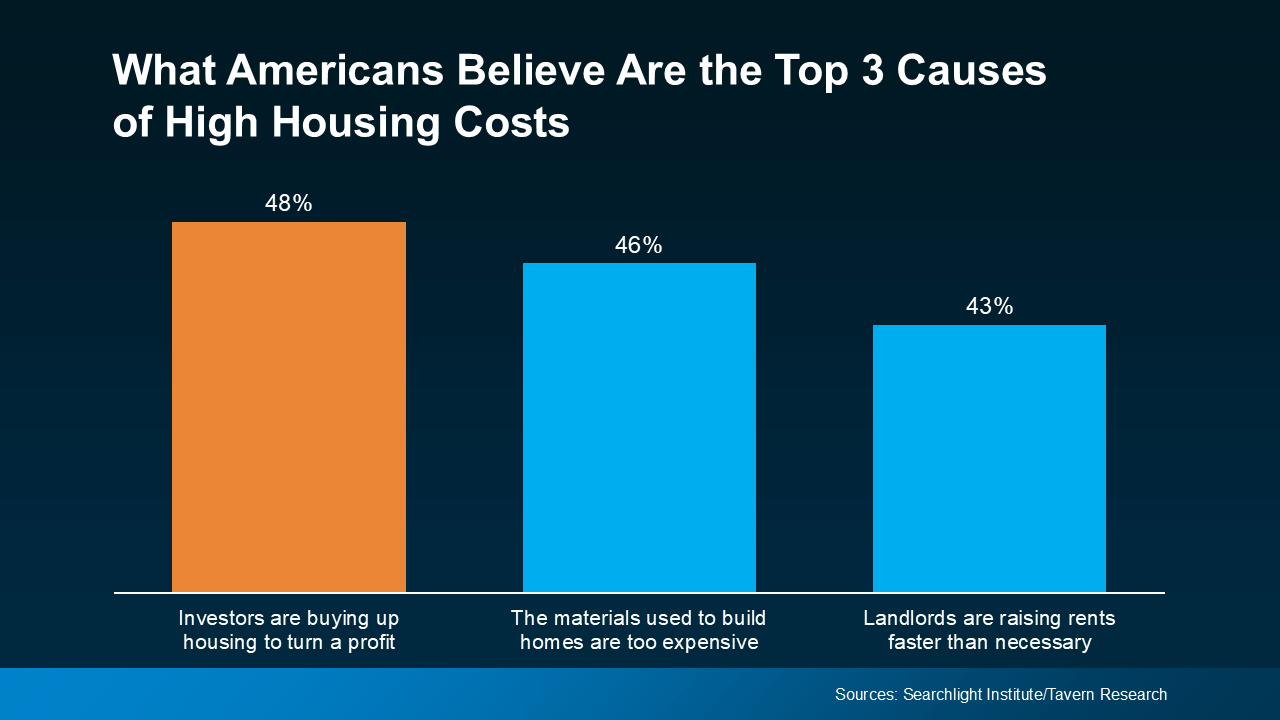 But that theory doesn’t actually hold up once you look at the data.
The Truth About Investors
Investors do play a role in the housing market, especially in certain areas. But they’re not buying up all the homes like so many people on social media say.
Nationwide, Realtor.com found only 2.8% of all home purchases last year were made by big investors (who own more than 50 properties). That means roughly 97% of homes were bought and sold by regular people, not corporate giants. Danielle Hale, Chief Economist at Realtor.com, explains:
“Investors do own significant shares of the housing stock in some neighborhoods, but nationwide, the share of investor-owned housing is not a major concern.”
So, if it’s not investors, why are home prices so high?
What’s Really Behind Today’s Home Prices
The real story behind rising prices has less to do with who’s buying and more to do with what’s missing: enough homes. Robert Dietz, Chief Economist at the National Association of Home Builders (NAHB), says:
“It’s been popular among some to blame investors, but with housing, the economics of that don’t make a lot of sense. The fundamental driver of housing costs is the shortage itself—it’s driven by the fact that there’s a mismatch between the number of households and the actual size of the housing stock.”
There simply haven’t been enough homes for sale to meet buyer demand. And that shortage, not investor activity, is what’s pushed prices higher just about everywhere.
Bottom Line
It’s easy to believe investors caused today’s housing challenges. But the truth is, the market just needs more homes, and that’s finally starting to happen.
As more options hit the market, buying may feel a little more realistic again.
Let’s connect and talk about what’s happening in our local market.
Read from source: “Click Me”
Questions, Comments or For more information you can call
Christian Penner Branch Manager at 561-316-6800 or email us at TheMortgageTeam@ChristianPenner.com
Approval Hotline: 561-316-6800
Helping You Achieve the American Dream of Home Ownership


Or You can click “Call Me” below to call Christian Penner directly using Google Voice






Do you know how much home you can afford?
Most people don’t... Find out in 10 minutes.
Get Pre-Approved Today